Stick to the Classics? Maybe Not. An Important Correction to Understanding Opera's New Audiences
New audiences want to see repertoire they’ve heard of, which includes classics and new works.
OPERA America’s 2024 Understanding Opera’s New Audiences study of opera newcomers rattled the field when it concluded that first-timers “tend to stick to the classics.”
After decades of industry-wide investment in new work, the research suggested that only inherited repertoire mattered.
Fortunately, that’s not quite right. When we returned to the data this year, here’s what we realized: New audiences want to see repertoire they’ve heard of, which includes classics and new works.
Of course, different audiences have different tastes, and different companies make different programming choices. The research doesn’t propose a one-size-fits-all strategy, but it does invite local conversations about the implications of repertoire on newcomers’ decisions.
Correction 1: It's Title Recognition that Matters
The original report suggested that new audiences gravitate toward “the classics.” However, in reaching that conclusion, we interpreted the survey language too narrowly.
When we designed the study, we wanted to know if audiences came for inherited repertoire or new work. But the average first-timer wouldn’t necessarily know that distinction. So, we used proxies. We asked if works were “famous or well-known” to signify inherited repertoire, and we asked about works by living creators, diverse artists, premieres, or pieces addressing contemporary themes to encompass new work.
In hindsight, this was a flawed alignment. For example, Alice in Wonderland (2007) by Unsuk Chin and David Henry Hwang, or The Shining (2016) by Paul Moravec and Mark Campbell, might be considered “new” from an industry standpoint, but audience members might classify them as “famous or well-known” because of their recognizable titles. A first-timer who attended Fire Shut Up in My Bones by Terence Blanchard and Kasi Lemmons after hearing about it in the news might have also considered that “famous or well-known.”
In reality, it is a work’s name recognition, rather than the age or status of the work, that appears to drive interest. During exploratory interviews held prior to the research survey, some newcomers spoke about how they were attracted to more well-known operas because they had some familiarity with them — if only with the title — which gave them the sense that it would be a good place to start.
That creates opportunities for all kinds of opera. Classics like Carmen and Aida certainly have name recognition, but so do new works like Moby-Dick (Jake Heggie and Gene Scheer) and The Scarlet Letter (Lori Laitman and David Mason).
Correction 2: Interest in New Work is Robust
The original report suggested a wide divide in newcomers' appetite for inherited repertoire and new work. But we overlooked an important dimension of the data that narrows the gap.
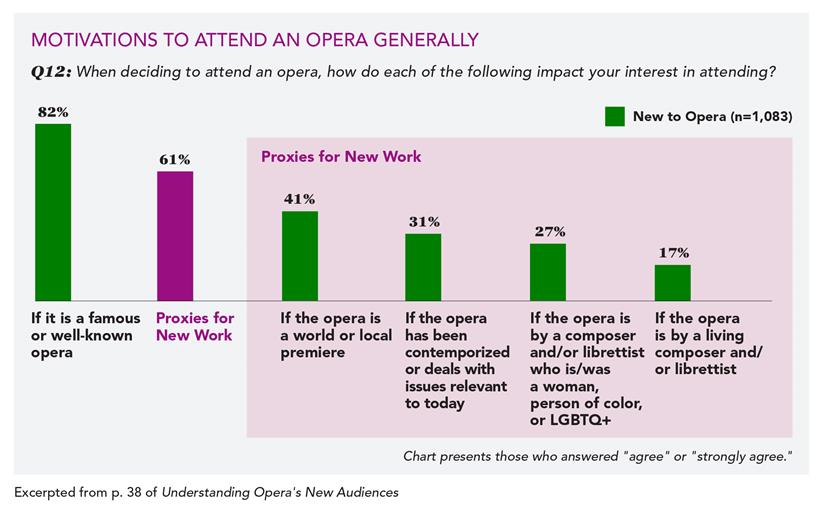
Interest in “famous or well-known opera,” the proxy for inherited repertoire, was at 82%, while interest in the new work proxies — premieres, contemporary issues, diverse artists, and living creators — ranged from just 17% to 41%.
As noted above, the 82% “famous or well-known” is more about name recognition than being inherited repertoire. Many new works qualify under that heading, even if the proxies for new work were individually so much lower.
But another way to look at the proxies for new work is to analyze them together: What percentage of newcomers were interested in at least one of the following?
- Attending a world or local premiere
- Seeing a work that addresses contemporary issues
- Seeing a work by a living composer or librettist
- Seeing a work by a woman, LGBTQIA+, or BIPOC creator
When the respondents to these four are uniquely combined, the number is much higher: 61% of newcomers expressed interest in at least one of them.
That significantly narrows the divide with the 82% who selected “famous or well-known.” And since the 82% encompasses a mixture of name-recognizable repertoire, the interest gap between inherited repertoire and new work is likely even smaller.
Correction 3: Newcomers Went to What Was Available
The original report suggested that “the classics” got people in the door. However, our conclusion was skewed by an availability bias.
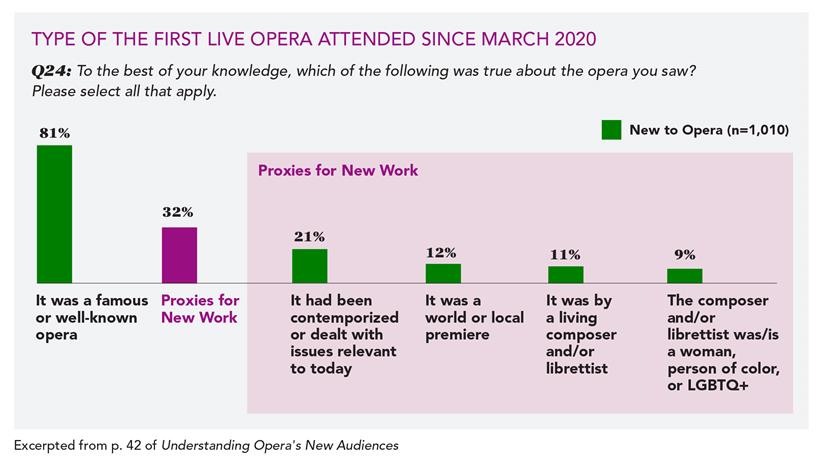
One argument for “sticking to the classics” in the original report was that was that 81% of newcomers described the first opera they attended — between March 2020 and May 2024 — as “famous or well-known.” Since this includes some new work, the true number for inherited repertoire is likely slightly lower.
Meanwhile, the proxies for new work were selected by just 9% to 21% of respondents. Even analyzedtogether, as described above, these new work proxies account for just 32%.
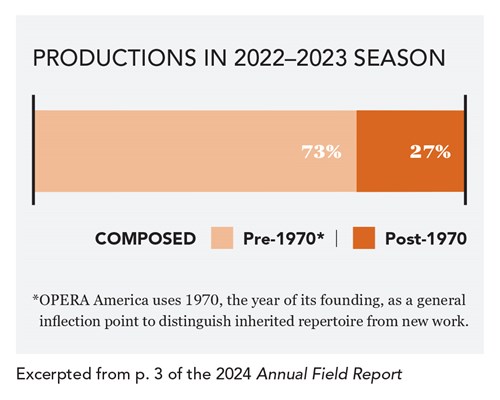
Interestingly, that distribution matches the distribution of what was available. In the 2022–2023 season, 73% of productions were composed before 1970 and 27% were composed after.
The predominance of “classics” is simply what their opera companies offered at the time, not necessarily a matter of preference. What first-timers reported seeing matched the volume of what was available.
OPERA America’s research into newcomer attendance retention is supported by the Dr. M. Lee Pearce Foundation. The Understanding Opera’s New Audiences research was supported in part by the National Endowment for the Arts, with additional leadership support by Bob Ellis, John Nesholm, and The Heinz Endowments.
Download a shareable PDF of this correction.