


My First 100 Days
Dear colleagues and friends,
One hundred days in, I feel two things at once — and I suspect you’ll recognize them, too.
First: Opera is a joy-making machine. I’ve been in rooms where the artistry was so exquisite it made time slow down. I’ve seen companies create beauty and belonging under pressure. I’ve felt the privilege of being in a form that can still crack a heart open in two hours.
Second: The field is carrying real weight right now. In room after room, the same pressures have surfaced plainly — tight economics, shifting philanthropy, exhausted teams, and the constant demand to compete for attention in a world that rarely sits still long enough.
And yet … I’m energized. Not because the work is easy, but because the appetite for change is real, serious, imaginative, and urgent. People are not asking for pep talks. They’re asking for progress.
What these first 100 days have given me
I didn’t come into this job with answers. I came in with respect and curiosity for what you’re navigating, what you’ve built, and what you’re being asked to hold.
So, like any serious student, I’ve spent these first months listening, learning, and staying close to the work.
That has meant nearly 60 hours of reading across books, articles, reports, and peer research; a dozen podcasts; and roughly 45 hours of online lectures that have challenged old assumptions and stretched my knowledge. It has meant attending three conferences, participating in four national panels and conversations, joining you for galas and gatherings, and spending time in opera houses and meeting rooms across the country.
More importantly, it has meant people. Over the course of these first 100 days, I’ve had the privilege of engaging in roughly 140 conversations across the field — with artists, administrators, trustees, donors, and leaders of partner organizations — along with 60 one-on-one meetings with OPERA America staff and board members. I’ve also taken in 25 operas and opera-related performances, because staying close to the art itself is as important as staying close to the institutions that support it.
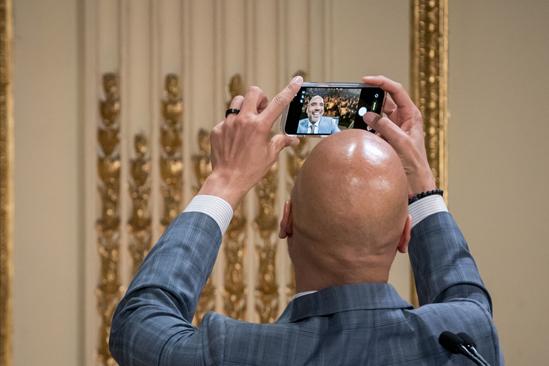
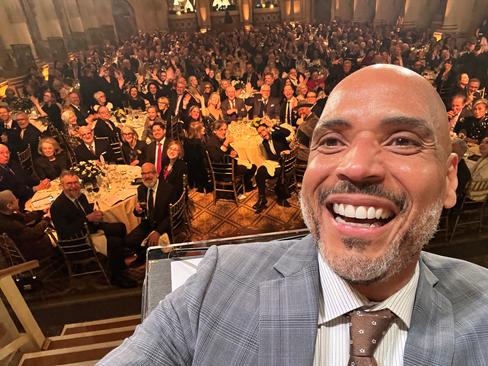
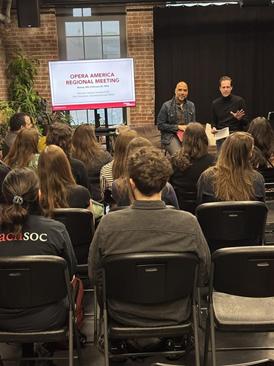
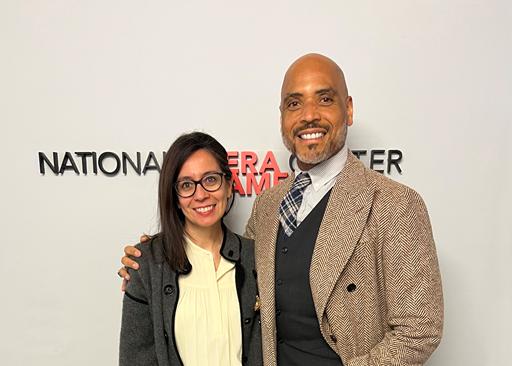
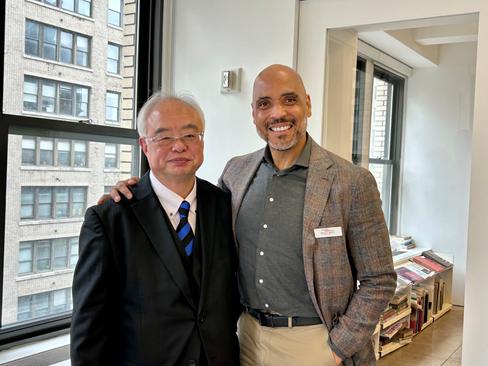
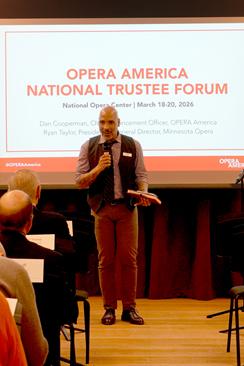
What all of that exposure has given me is not a checklist, but a clearer understanding of the moment we are in. It has deepened my respect for the extraordinary rigor, creativity, and resilience across this field. It has also sharpened my view of the barriers so many of you are navigating: financial strain, cultural headwinds, workforce fatigue, uneven access to tools and networks, and a growing urgency to rethink how opera earns relevance in contemporary life.
None of this has been about optics. It has been about building the kind of grounded understanding that can help OPERA America become more useful, more responsive, and more indispensable to the field now and in the future. My commitment is to do what I can to help opera grow — and to be transparent about what I’m seeing, including the hard truths.
What is emerging across the field
Across cities and stakeholder groups, the themes have been remarkably consistent. There is immense pride in American opera — its talent, ambition, and rigor — and in the sheer excellence of the work being made. Alongside that pride is real concern about financial sustainability, the balance of earned and contributed revenue, and the generational and societal changes reshaping philanthropy in real time.
A strong desire is emerging to rebuild opera’s public-facing relevance. People want new ways to introduce opera to newcomers, retain first-timers, and make the experience something people return to because it feels personal, meaningful, and alive. There is an appetite for a stronger public narrative: confident, contemporary, culturally fluent, and oriented toward increasing relevance and participation.
The future of the field feels especially important when it comes to young audiences, young artists, and the talent pipeline. Questions keep surfacing about how opera connects to youth culture, how we partner more effectively with schools and universities, and how we prepare artists, administrators, and leaders for today’s economy, not yesterday’s.
There is also an important opportunity here: to share the burden of producing and creating opera by allowing more of our full community to help ideate and problem-solve. A sector full of creatives is an extraordinary asset, but everyone must be uniformly informed about the distinct challenges tied to the many roles and responsibilities within the opera ecosystem.
Support for new work and new voices remains strong, but so does frustration with what happens after a premiere. Many are asking for better pathways for creators, clearer systems of opportunity, and more reliable ways to find, share, and circulate resources.
And then there is the question of member experience and belonging. Some of you have said plainly that OPERA America can feel like an insider’s club. Some networks do not always feel useful. Some tools are hard to find. Data can be difficult to apply across markets. And the conference does not always feel designed for smaller companies or artists. That matters, because it is not just feedback. It is about trust — about whether OPERA America truly feels like it belongs to the whole field. I take that seriously. As I challenge the field, I am also challenging our board, our staff, our supporters, and myself to interrogate every part of how we serve and advance opera.
A call to action: from admiring problems to building futures
There’s a pattern I’ve seen across sectors — and we’re not immune to it. I’ll call it the “admiration of problems.”
We are exceptionally good at naming what concerns us. We can describe the dynamics, diagnose the constraints, and revisit the same pain points in room after room, over time, with increasing precision. But diagnosis is not transformation. And in a moment of real economic stress, audience volatility, and workforce fatigue, we do not have the luxury of rehearsing our challenges without building our responses.
So here is my invitation — maybe even my challenge — to all of us: Let’s shift from admiration to interrogation. From complaint to curiosity. From “this is why we can’t” to “what if we did this?”
That shift requires something specific: innovation as discipline. Prototyping. Testing. Learning. Iterating. Sharing what works so the whole field gets stronger, not just one company at a time.
It also requires that we look beyond ourselves. We can learn from sports and concerts about fandom, ritual, and loyalty; from film and gaming about anticipation, release cycles, and community; from the travel industry about habit and brand attachment; from hotels about radical hospitality and frictionless experience; and from amusement parks about shaping a complete journey from arrival to departure. In Massachusetts, I saw the power of this kind of cross-sector thinking firsthand when we launched the first statewide arts prescribing initiative in the nation, connecting health care providers, insurers, managed care plans, opioid settlement funding, housing resources, and arts organizations around a shared solution.
We should also be studying sectors like environmental advocacy, agriculture, and trucking to understand how they organize politically, build coalitions, sharpen their asks, and sustain public will. These are not artistic distractions. They are playbooks for how culture becomes irresistible and how ecosystems protect what they value.
At the same time, we cannot innovate our way out of structural weakness if we ignore systems issues. The field is asking hard and necessary questions: How are we preparing people for the realities of life and work in opera? What is missing from training, education, and workforce preparation? How do we smooth the transition between school and the profession? If we do not address those foundational gaps — economic, educational, political, and cultural — then even our best ideas will be temporary. The future cannot rest on passion alone.
And here is the truth that matters most: Some of what constrains us was built within our own systems, reinforced by our own habits, or tolerated for too long. This means the responsibility to change it belongs to all of us. Let me be equally clear: OPERA America has a responsibility to lead by example. We cannot ask the field to be more open, more inventive, or more inclusive than we are willing to be ourselves. We have to examine what no longer serves, change how we convene, change how we support, and build on the trust required to help move the field forward. This is collective work — among artists, administrators, trustees, educators, funders, unions, publishers, partners, and OPERA America — but shared responsibility only works when leadership begins at home.
That will create discomfort. But I’ve learned that avoiding what needs to be done or said does not preserve harmony; it prolongs the problem. Candor, paired with care, is not division. It is the beginning of real work.
A small story (and a reminder that the “impossible” moves fast)
A couple of years ago, I heard my nieces singing “Caro mio ben” and “Ave Maria.” I asked them where they learned those songs. Their answer was one word: Beyoncé. She didn’t just reintroduce a whole group of people to country music, she sparked curiosity that led two kids to art songs.
That kind of cultural movement matters because it reminds us that audience behavior is not fixed. Reference points shift. Curiosity travels. New gateways open all the time.
Now, my niece Meleah and I occasionally FaceTime to sing snippets of “Golden” from KPop Demon Hunters, even though a year ago we didn’t have a shared reference point for K-pop. And when everyone was buying those Labubu dolls … I wanted one too. My point is simple: The cultural zeitgeist shifts fast. The seemingly impossible becomes normal more quickly than we think.
Increased consumption in opera is not a fantasy. The question is whether we are curious — and bold — enough to rethink how we produce it, present it, package it, and welcome people into it.
I’m ready to work differently. I hope you are too. We have the remarkable ability to open a blank document or score and create whole new operatic worlds in a short amount of time. Surely we can bring that same imagination to the business, structures, and public experience of opera itself.
What you can expect next
In the months ahead, we’ll share a synthesis of themes from the listening tour with the full field. That synthesis will inform an interim strategic plan: a practical, measurable guide that will help us prioritize what OPERA America focuses on now, while we prepare for a full strategic planning process.
My commitment is simple: to build OPERA America’s capacity and infrastructure so we can help the field confront the economic and cultural realities of this moment with courage and clarity, while keeping the artistry and joy at the center of opera.
Thank you for welcoming me, challenging me, and being honest. I’m grateful for the trust you’ve extended — and I’m ready to keep earning it. And yes: I hope you’ll allow me to challenge you, too.
With respect and admiration,
Michael J. Bobbitt
President/CEO, OPERA America