OPERA America's National Opera Center is a communal home for opera and the performing arts in New York City. Make it your place for recitals, rehearsals, recordings, and more.
Learn More & Rent Now
Award-winning puppeteer Basil Twist’s stylized creations have appeared on many of the world’s greatest stages. The San Francisco native’s production credits range from The Nutcracker with the Joffrey Ballet and Petrushka with Lincoln Center to Aida with the English National Opera and Otello at the Wiener Staatsoper.
My grandmother just loved the opera and music. She actually took me to my first opera, Carmen at San Francisco Opera, and I just thought it was so cool. I was immediately intrigued by all things Carmen and Spain, and I started falling in love with the art form myself.
Both puppetry and music run in my family. My mother was an amateur puppeteer when I was growing up, and her father, Gene Williams, was a big band leader who sometimes included puppets in his performances. He died before I was born, but when I was young, my grandmother — the one who took me to the opera — gave me his old puppets. They were puppets of famous American band leaders like Harry James and Cab Calloway, and I still have those. That just sealed the deal for me, and I kept pursuing puppetry and eventually attended puppetry school in France, the École Nationale Supérieure des Arts de la Marionnette in Charleville-Mézières.
I think of puppetry as its own distinct art form. But the way that I see it, it’s more closely aligned with dance than, say, theater. My early shows were focused on music, like Berlioz’s Symphonie fantastique or Stravinsky’s ballet Petrushka. I use music more like a dancer or a choreographer; I render music in visual form. Puppetry easily brings us into the realm of imagination, which works well with operas, as the stories generally aren’t super realistic anyway. Currently, I’m working with Huang Ruo on a couple of projects, Book of Mountains and Seas and The Monkey King, which are very much in the realm of fantasy and take some really thrilling stagecraft to create.
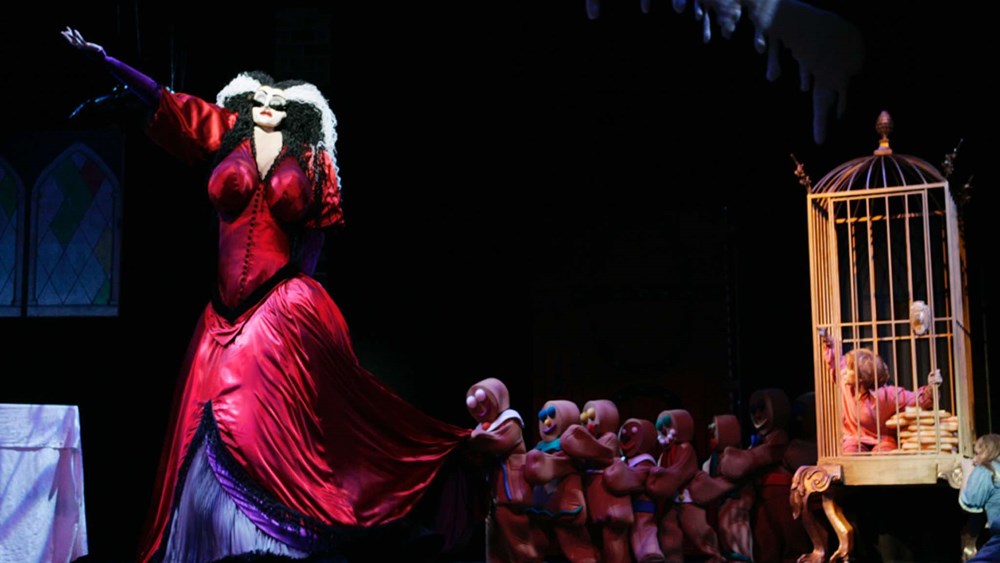
Twist’s 2006 Hansel and Gretel at Houston Grand Opera (photo: Bretty Coomer)
My first major opera project was Hansel and Gretel with Houston Grand Opera. I found that the key thing when working with both singers and puppets is that the singers have to be both adventurous and very good. I built this amazing witch for Hansel and Gretel that actually had the singer inside of it, and we had to go through a couple of different performers because it was so physically challenging. It was thrilling, but I’ve tried to avoid creating that situation again, because in opera, the stagecraft has to serve the voice and the character and the narrative. I absolutely love working with singers — and even if I try and keep it fairly simple, I’m still pushing them outside of their comfort zones a little. It can make for a really exciting performance!