OPERA America’s 2024 study of opera newcomers, Understanding Opera’s New Audiences, rattled the field when it concluded that opera first-timers “tend to stick to the classics.” After decades of industry-wide investment in new work, the research — based on a survey of 11,000 opera attendees — appeared to suggest that only inherited repertoire mattered.
Fortunately, that’s not quite right. When OPERA America returned to the data this year, it came to a new conclusion: New audiences want to see repertoire they’ve heard of, which includes classics and new works. A new OPERA America report, Stick to the Classics? Maybe Not., explains this revised understanding and offers three important corrections to the original report.
Correction #1:
It’s title recognition that matters.
The survey on which Understanding was based aimed to discover if audiences came for inherited repertoire or new work. Because the average first-timer wouldn’t necessarily understand that distinction, the survey used proxies, asking if works were “famous or well-known” to signify inherited repertoire, and asking about works that are by living composes and diverse artists, premieres, or pieces addressing contemporary themes to encompass new work.
The Understanding report suggested that new audiences gravitated toward “the classics” (i.e, inherited repertoire) since most survey respondents said they attended famous or well-known works. In hindsight, this was a flawed alignment, as new works like Alice in Wonderland (Unsuk Chin/David Henry Hwang) or The Shining (Paul Moravec/ Mark Campbell), for example, could also be considered “famous or well known” due to their recognizable titles.
In reality, it is a work’s name recognition, rather than its age or status, that appears to drive interest. During exploratory interviews held before the research survey, some newcomers spoke about how they were attracted to more well-known operas because they had some familiarity with them — if only with the title.
Correction #2:
Interest in new work is robust.
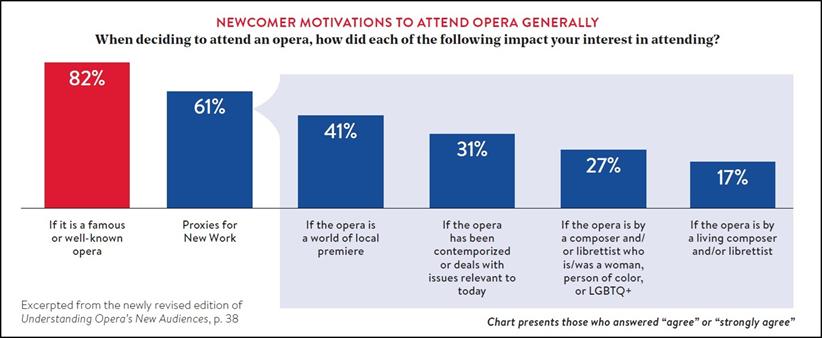
The original report suggested a wide divide in newcomers’ appetite for inherited repertoire and new work. Interest in the proxy for inherited repertoire — “famous or well-known opera” — was at 82%, while interest in the new work proxies — premieres, contemporary issues, diverse artists, and living creators — ranged from just 17% to 41%.
However, when the respondents to these four new work proxies are uniquely combined, the number is much higher: 61% of newcomers expressed interest in at least one of them, as shown in the newly revised chart below. Plus, because the 82% figure encompasses a mixture of name-recognizable repertoire, the interest gap between inherited repertoire and new work is likely even smaller.