



The tech advancements shaping new operatic productions
There is an inherent tension between opera and certain kinds of technology. On the one hand, the opera field has long been an early adopter of innovative technology and stagecraft, from special effects machinery in the 1600s to the digital projections that have become so prevalent today. On the other hand, it is an art form with a strong and storied sense of tradition, and there is a reluctance in some corners to innovate purely for the sake of doing so.
Where is the line, then? How “immersive” must the projections become and how “augmented” must a production be before the “opera” iterates too far beyond its roots?
Currently, the motives for using technology fall into three categories. First and foremost, creatives are exploring ways to employ tech in a manner that enhances artistic quality. Second, the efficiency of certain kinds of technology has allowed leaders to be creative in trimming costs, from designing sets in virtual reality to using artificial intelligence to streamline administrative tasks.
Finally, some leaders argue that the use of technology draws new attendees to the art form, both through digitally distributed productions and because of the novelty of some of the tech itself. “My audience is much younger and doesn’t have a fixed idea what opera should be,” says Cerise Jacobs, founder and artistic director of White Snake Projects, a small activist opera company in Boston that regularly weaves tech into its productions. “They’ve been raised on Netflix and video games. We need to use technology as a way to more totally engage them. This is the future.”
Leaders and creatives are currently discussing how amplifying singers, developing scenery in video game coding engines, and more can improve a night at the opera and integrate its grand tradition with cutting-edge stagecraft.
New Sounds
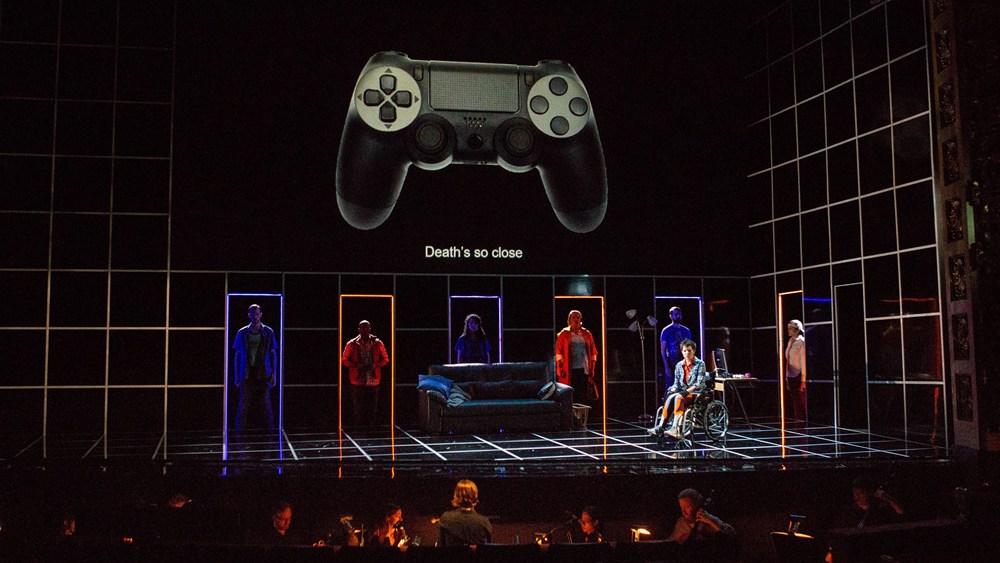
As a director at DreamWorks Animation, Tim Johnson is intimately familiar with using technology in the service of stories. “If you look at innovations in the world of film, I would argue that the most aggressive and successful technical innovations have happened in the world of audio,” says Johnson, also a board member at Los Angeles Opera, pointing to technologies like Dolby Atmos and the quality of audio recording. He’s interested in exploring the use of some of that tech in the opera field: “I think that opera can be a little precious about its observance of the microphone-less past to the point where we might be shutting down opportunities for clever creative voices to improve the opera experience.” Johnson isn’t in any way arguing that all singers should be miked — “filling a hall unamplified is a glorious athletic achievement for our singers and orchestras” — but that a broad taboo against the practice is perhaps limiting.
The opposition to miking singers is already fading. Many companies have demonstrated an openness to miking orchestras and singers alike to help fine-tune their sound, especially at non-traditional venues. Composer Kamala Sankaram, who has written for amplified musicians and singers previously and is currently working on projects with amplification, attributes the reluctance in part to a traditional deference to acoustic sounds in the opera world. “There hasn’t been a very robust pool of audio engineers who specialize in live miking of classical voices because that’s something that was just not being asked for,” she says. “That’s obviously changing as more composers choose to amplify. I think these things feed back into each other. No pun intended.”
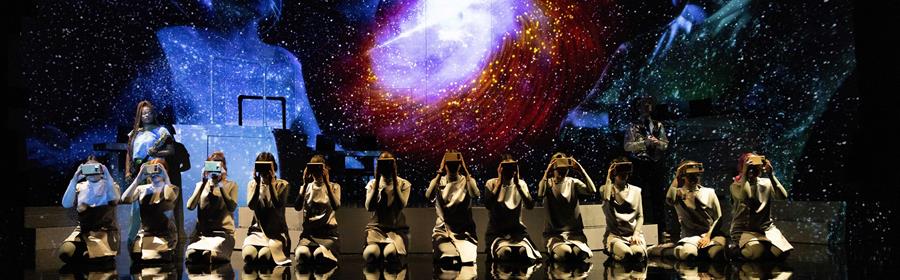
The company Opera on Tap, which is based in New York City and has affiliates around the country, is currently developing a site-specific new work called Joan of the City (which has received grant support from OPERA America) that will use both augmented reality goggles and bone conduction headphones, which transmit sound waves through the wearer’s skull rather than the ear canal. This will be an immersive, site-specific work focusing on women experiencing homelessness. Attendees will be able to follow one of five Joans around the installation, with the goggles and headphones allowing them to experience the Joans’ audio-visual hallucinations. “The idea is that you’ll be able to hear the live singer, but you’ll also hear an audio layer through the headphones,” says company founder and director Anne Hiatt, adding that using headphones can make opera more accessible, too.
Composer Christopher Cerrone, who wrote the music to the opera In a Grove (libretto by Stephanie Fleischmann), didn’t call for headphones for his opera, but he did mike the singers for narrative reasons: “Music can help get into the psychology of a character,” he says. For example, he says that granulation and subtle reverberation and distortion effects in the music are meant to emphasize that a character’s memory has been damaged. Other composers are beginning to explore similar narrative techniques, as well.
Emotional Intimacy
An inherent fear of using technology is that it can add a layer of mediation and separation between stage and attendee, but some leaders argue that the opposite is true. Amplifying singers can allow them to employ a much larger dynamic range than they can use in a traditional hall. Imagine the difference between singing “I love you” from a great distance to whispering it directly into someone’s ear.
The same can be true on the visual side. David Bennett, general director at San Diego Opera, says that it’s this sort of intimacy that has kept his interest in advancing tech. During the pandemic, SDO programmed drive-in operas that allowed attendees to socially distance in their cars while watching a live performance simulcasted on large screens. “The big takeaway for us was that if it’s directed, then you have these really beautiful moments of intimacy,” he says, explaining that camera close-ups of the singers’ faces allowed attendees to see their expressions and other details during the performance much more clearly that they would have without the projections.
“I wanted to bring that sense of intimacy that we experienced in the drive-in into our 3,000-seat hall,” Bennett says. The company has since used live video capture and projectors during productions to showcase characters’ inner turmoil in the same detail.
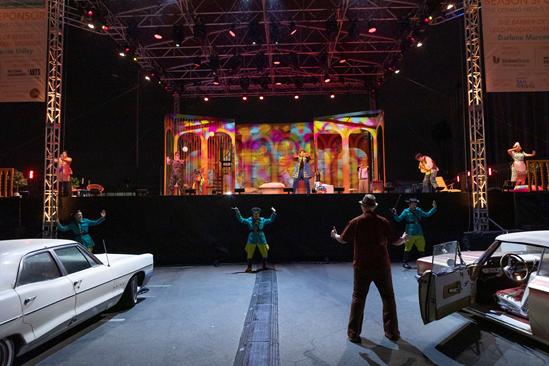
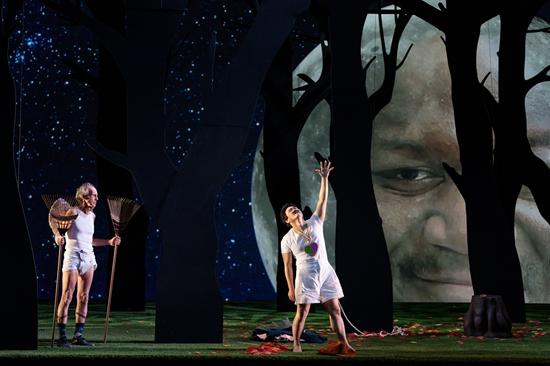
Audiences have responded well to such advancements, Bennett says. San Diego owns its own projector and regularly uses it to project both two- and three-dimensional set pieces in its theater to make shows feel more immersive. Costs for such visual technology have diminished considerably since it first became available, to the point that many opera companies of various sizes can afford to either rent or purchase a projector. (Bennett says for San Diego Opera, the projections can run about $20,000 per production.) Plus, there are other financial benefits. “By reducing the amount of physical stuff on stage, there are all kind of implications for reducing labor,” Bennett says, noting that employing screens can help bring down the price of building and storing sets, load-in and crew, and shipping costs. These expenses have increased significantly in recent years due to inflation, prompting many companies to explore digital scenery options and even programming concert opera or staged concert opera.
There has been some interest in LED walls as well, which combine different LED panels together to cover a large area. They are functionally similar to projections, but these walls can display sharper, higher-resolution images than some projectors. At present, they seem prohibitively expensive for the majority of the field, according to several company leaders interviewed for this story. “We can use projectors for the same 3D elements that you’d get on an LED screen,” says Jacobs, who notes that White Snakes Project is already using software to build a mix of two-dimensional and three-dimensional elements that give a sense of depth and immersion. Jacobs also says that finding contractors with the know-how to work with software like Unreal Engine, a subscription-based 3D creation tool commonly used in video game development, can be “very expensive.”
Bennett agrees: “I’m not saying that’s something I wouldn’t be interested in in the future — I definitely am. But I think there are intermediate steps, like training your in-house staff now to be more comfortable with projectors and digital content, which is not particularly expensive.”
Virtual Stages
Other companies are fine-tuning ways to use tech to save time and funds, as well. Overseas, the Finnish National Opera and Ballet created an “extended reality” (XR) model of its stage to allow set designers, stage directors, and technical directors to collaborate in real time on a digital model of a set. The company used a laser scan to map the physical space and then used Unreal Engine to play with different physical elements to design the sets in virtual reality.
The company estimates that utilizing XR technology saved about 1,500 working hours and shaved about 20% of their production costs. The savings were realized in reduced material and labor costs and reduced travel for production teams.
“We have received quite a lot of interest, and we are working with other companies like the Royal Shakespeare Company and the Royal Opera House,” says Hannu Järvensivu, the manager of this project at FNO. (He notes that the Royal Opera House is interested first in using the model on its ticketing platform to show a virtual view of the stage from every seat to prospective ticket buyers.) “It can take only a couple of weeks to embed this model at another company if they can find people with the right technical experience,” he adds. XR tech also uses Unreal Engine, which Järvensivu says only costs a couple of hundred dollars in licensing fees a year.
The team at FNO emphasizes that the ultimate purpose of such a tool is to concentrate resources on the artistic side of the operation and serve what’s happening on stage. “It sounds fancy, but the whole point is to be able to use more resources on the stage and serve the audience better,” Järvensivu says.
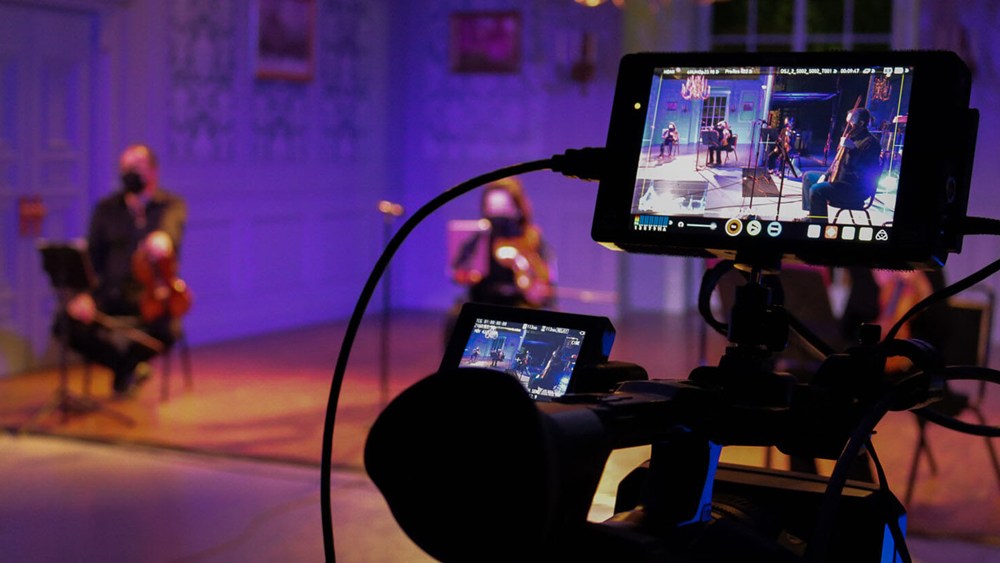
Some companies are continuing to explore uses for virtual performances. Opera San José, for example, developed its Heiman Digital Media Studio, a digital performance space for livestreaming and recording performances. Some companies pivoted away from virtual experiences once in-person performances became possible again, but San José’s general director and CEO, Shawna Lucey, says that part of the company’s mission is to “develop the next generation of opera talent.” Providing young singers with a chance to work on camera each year is a critical point of development for singers who may need to work with video directors for digital recordings or even live projections, she says.
Jacobs says that White Snake Projects is also continuing to develop a digital studio, Tutti Remote, which allows performers in multiple locations to perform synchronously without lag. (Lag, or latency, was the great challenge of remote performances during the pandemic years.) “It is totally uncompressed, true audio, with lag reduced to less than a single frame,” she says. “This is practically zero latency.” Such technology could allow directors and singers in multiple locations to begin rehearsing remotely, perhaps another way to whittle down production costs. It will also allow White Snake Projects to create virtual operas at low cost and build a library of performances.
“I think every opera company wants to be ready for the audience of the future, today,” says Lucey. “Just as we want traditional Strauss and Mozart, we also want the opera that’s coming by somebody who’s only three years old right now. And that means we need to continue deploying these technologies on stage and see how the music works with them to tell us the tales we know and the tales that we haven’t imagined yet.”
This article was published in the Fall 2024 issue of Opera America Magazine.

Jeremy Reynolds
Jeremy Reynolds is the editor of Opera America Magazine, and he also writes about classical music for Opera, the Pittsburgh Post-Gazette, Symphony Magazine, and The New York Times.