OPERA America's National Opera Center is a communal home for opera and the performing arts in New York City. Make it your place for recitals, rehearsals, recordings, and more.
Learn More & Rent Now
Among summer’s new operas were a battle of wines, Afrofuturism, and a fresh Shakespeare adaptation
Share
A quarterly roundup of North American world premieres.
Afrofuturism Triumphs in Cincinnati
In July, Cincinnati Opera delivered the world-premiere production of the Afrofuturist opera Lalovavi (Kevin Day, composer; Tifara Brown, librettist), the first installment of the company’s Black Opera Project, intended to feature stories of Black joy in opera. The opera takes place 400 years in the future after a global catastrophe and follows Persephone, the daughter of an authoritarian ruler, as she flees into exile due to her rare and coveted genetics.
The opera played to two sold-out houses and exceeded sales expectations, according to the company. There are inquiries from other companies about additional productions, but no signed contracts as of publication.
Brittany Olivia Logan, Adrienne Danrich, and the company of Lalovavi at Cincinnati Opera (photo: Philip Groshong)
It also generated significant critical buzz. Writing for The Wall Street Journal, critic Heidi Waleson noted the “lavish” production’s “lushly orchestrated score, sweetly tonal throughout and full of harp riffs,” though she concluded that the production was “too long.” Janelle Gelfand, meanwhile, writing for the Cincinnati Business Times, praised the production as “a triumph of singing and storytelling.”
New Tennessee Williams Adaptation
A new 75-minute operatic adaptation of the Tennessee Williams play Suddenly Last Summer, with music by Courtney Bryan and a libretto by Gideon Lester and Daniel Fish, premiered on June 25 at the Fisher Center at Bard and reprises at Opera Philadelphia in October. The operatic adaptation slightly condenses the play, which follows a woman as she tells the story of her cousin’s death while the cousin’s mother attempts to silence her through a lobotomy.
The production played to capacity houses and exceeded sales projections, according to the company. Writing for The New York Times, critic Joshua Barone noted: “If the production doesn’t exactly conjure the sultriness of New Orleans, the music does. Chords build one note at a time, like sunlight emerging from around a corner; melodies melt with downward glissandos, and [Mikaela] Bennett similarly bends pitches, soulfully scooping her way into a note.”
Mikaela Bennett in Suddenly Last Summer at the Fisher Center at Bard (photo: Maria Baranova)
Memory Care, AI, and Opera
The 70-minute chamber opera Water Memory (Kitty Brazelton, composer; Vaibu Mohan, librettist) premiered on June 12 as a partnership between The Atlanta Opera and Georgia Tech Arts at the school’s Ferst Center for the Arts to an audience of more than 600. In the opera, a woman’s daughter and son settle on a robot, a “Memory Processing Operator,” to help collect and rescue their mother’s memories as she experiences dementia.
The opera is an artistic exploration of the latest developments in AI-assisted caregiving. Its score uses a software platform that allows for the manipulation of sound in real time, blending human voice with electronic elements. The work began its life as a 10-minute scene in The Atlanta Opera’s competitive 96-Hour Opera Project, which the creators expanded into a chamber opera after winning in 2024. A film of the work is available on The Atlanta Opera Film Studio.
The Atlanta Opera’s Water Memory, with Tanushka Sisodiya, Joseph Istoop, and Indira Mahajan (photo: Raftermen)
Battle of the Wines
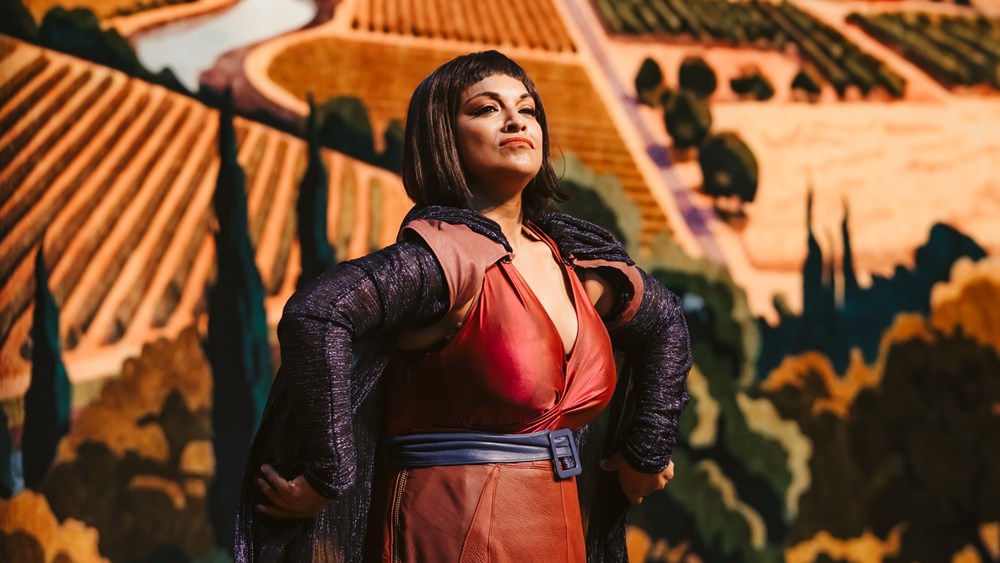
In 1976, Napa Valley wines exploded onto the global stage after a fateful blind tasting. Fifty years later, composer Jake Heggie and librettist Gene Scheer premiered a one-act comic opera titled The Judgment of Paris to celebrate the anniversary on the Festival Napa Valley Stage. The plot sees the gods Bacchus and Venus competing in a wine tasting. Spoiler: California wines win the laurels over their French counterparts, just as they did in 1976.
The opera, which the company noted was “created and completed in just over a year,” had a single performance on July 18 and sold out with a waitlist. It will travel next to the Frost School of Music at the University of Miami in February 2027 and the Royal Opera of Versailles in April 2027. (Versailles co-produced the work with Festival Napa Valley.)
Danielle de Niese in The Judgment of Paris at Festival Napa Valley (photo: Lisa Fonville/Hemlock House, Inc.)
Critic Joshua Kosman wrote in The San Francisco Chronicle that “the allure of Heggie and Scheer’s creation ranges far beyond the specifics of time and place. It’s a marvelous musical and theatrical invention, infused with the comic spirit of Offenbach, and it tells its story with a perfect balance of seriousness and breathless farce.”
Teatro Grattacielo’s The Tempest, with (clockwise from top left) Chantelle Grant, Maggie Finnegan, Sarah Johnson, Kathryn Guthrie, and Heather Green (photo: Jennifer Katzman and Steven Pisano )
Shakespeare as Opera
After a decade-plus incubation period that included a concert performance and recording in 2015, the New York City opera company Teatro Grattacielo brought composer Joseph Summer’s adaptation of Shakespeare’s The Tempest to the stage with a libretto by his daughter, Eve Summer. The opera reimagines Prospero as an exiled filmmaker instead of the Bard’s duke. The production sold out, and the company, Joseph Summer, and foundation partners have agreed to create three additional world-premiere operas inspired by Giovanni Boccaccio’s The Decameron.
In The National Herald, Yanna Katsageorgi wrote: “The melodic lines follow the cadence of Shakespeare’s language, the vocal writing serves the characters, and the score becomes a vehicle for emotion rather than an end in itself. Instead of overwhelming Shakespeare, the opera enters into a genuine dialogue with him.” ■
OPERA America members are invited to submit news items to PressReleases@operaamerica.org for consideration for inclusion in the magazine.