


What can North American opera companies learn from the Vienna State Opera's subtitles?
This April, I attended Opera Europa’s spring conference in Vienna. It was one of their largest meetings ever, with rich sessions featuring leaders from the city’s four opera houses and many others. For all the high-level discussion and novel ideas presented at the conference, you might be surprised that one of my biggest takeaways for my North American colleagues had to do with subtitles.
After the final conference session, I dashed out to catch a few local sights, then back to my hotel for a catnap and shower. I’d left just enough time to scarf down a slice of Sacher torte before the evening’s performance: Simon Boccanegra at the Vienna State Opera.
It was my first Simon, and as I rushed to the theater, I skimmed an impenetrably written synopsis on my phone that told me almost nothing of what the opera was about. With lobby chimes ringing, I ran to my seat, flipped open the seat-back subtitle screen, and selected English. It was go-time.
I had an absolutely wonderful evening at the opera. For the first time in my life, I followed every twist and turn in the plot. Why? Well, the extraordinary musicality of the singers and orchestra helped, but I attribute it to one small favor the Vienna State Opera did for me: Each line of translated text was preceded by the character’s name. That was it. That tiny extra bit of text, displayed in smaller font above the libretto lines, meant that I knew who was saying what at every moment.
What a gift for a first-timer!
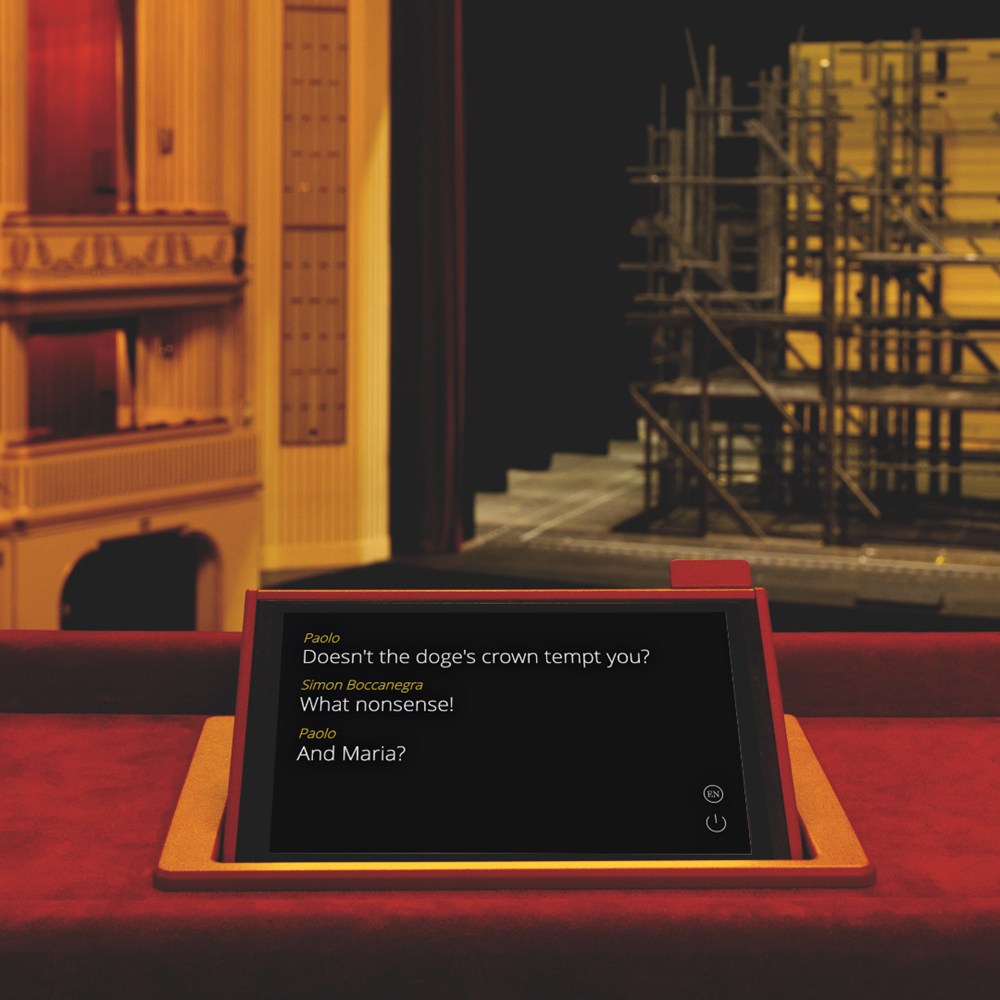
It was an important reminder that our experience at the opera could be made easier with very little effort. I have a master’s degree in musicology, work in the field, have seen more opera than your average Joe, and much of the time even I can’t keep track of who’s who. It’s nearly impossible when all the characters’ names are so similar and I can hardly see whose mouth is moving from high up in the cheap seats.
If having characters’ names displayed was a gift for me, imagine what that could do for a real firsttimer. Yes, the Vienna State Opera has the benefit of larger, individual screens rather than the above-the-stage projections most of our companies use, but surely we could spare such a tiny bit of digital space on our screens.
What else could we do to make the experience easier for first-timers? Let’s go back to the synopsis. First of all, most newcomers to our opera house fly in after a rushed dinner and make it to their seats with little time to spare. If they’ve never been to the opera, do they know how helpful it is to read the synopsis? Probably not. In what other theatrical art form are you supposed to spoil the plot before it even happens? If they do know to read the synopsis, do they have time to find it buried in the program book? And is the dense, archaically written, scene-by-scene, so-called “summary” at all useful?
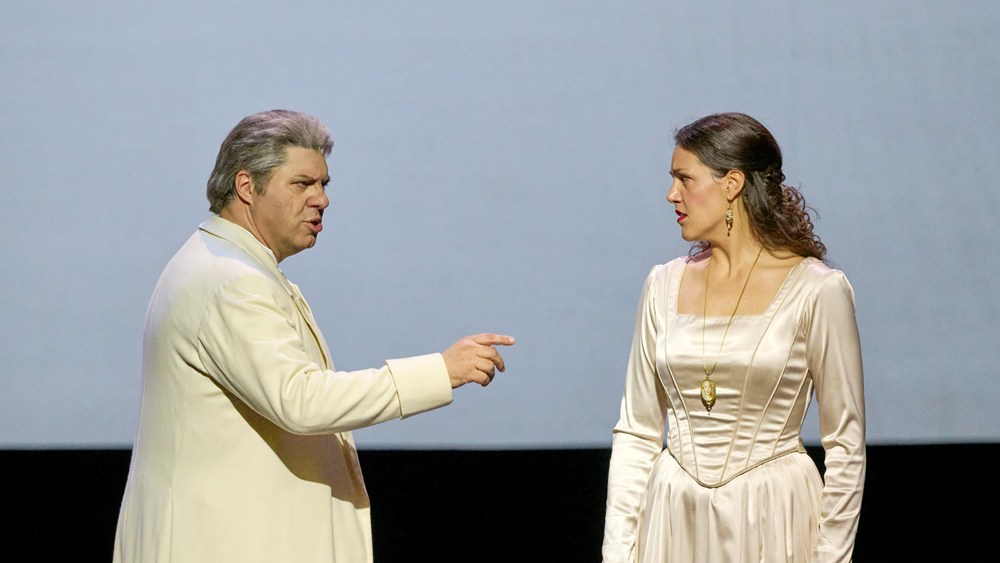
Again, I commend the Vienna State Opera. On my little seatback screen was a three-sentence summary of Simon Boccanegra that read as an excerpt from a season brochure. And I think we could go farther — what if we introduced a true summary into our program books, in easy-to-read sentences, just ahead of the full synopsis? Something like: “Simon Boccanegra is a newly appointed ruler who always goes high when others go low. His faith in fairness and decency is put to the test when his long-lost daughter declares her love for his enemy. Still, as Boccanegra dies from the poison of his defectors, he demonstrates the importance of forgiveness.”
That’s all you really need to know to follow along, especially when you have character names. And what if that summary were preceded by a helpful tip? “Is this your first time here? We recommend you read this.” And what if this began on page one of the program book? Along with an interpretation statement? And photos of the characters in costume?
I’m sure we could come up with even more ideas about little tweaks that could have a huge impact for first-timers. You might even be able to A/B test some of these with audience surveys. This year, OPERA America actually has partnered with Slover Linett at NORC, a premier cultural research firm at the University of Chicago, to survey the record numbers of first-timers at opera companies across the U.S. What brought them in? How was their experience? What would bring them back?
We need not wait for the final report to start making changes. For years we’ve focused on shortening bathroom lines and enhancing the intermission bar to improve people’s experiences. If our first-timers can’t understand what’s happening on stage, all of that is for naught.
It’s ironic. When I told my taxi driver from the Vienna airport that I hadn’t visited since 2007, she admitted with resignation, “Nothing changes in this city.” And yet, it was in Vienna that the simplest of changes gave me one of my most satisfying nights at the opera.
This article was published in the Summer 2024 issue of Opera America Magazine.

Dan Cooperman
Dan Cooperman is OPERA America's chief advancement officer.